






















WhatsApp Business API: The 2026 Conversational Commerce Guide
Introduction
Here's a gap worth pausing on: India has over 500 million WhatsApp users, and urban smartphone adoption of the app now exceeds 70%, yet by our best estimate only around 7% of Indian SMBs with more than 50 employees are actually using the WhatsApp Cloud API — the version that enables genuine automation, structured commerce flows, and CRM integration. The overwhelming majority of businesses on WhatsApp are still using the free consumer Business app, which is fine for answering a query but structurally incapable of the automated, catalogue-driven, payment-integrated experience customers increasingly expect.
That gap is either a warning sign or an opportunity, depending on which side of it a business sits on. This article covers what conversational commerce on WhatsApp actually looks like when it's built properly in 2026, and why the businesses treating it as core infrastructure rather than an afterthought are pulling meaningfully ahead.
Why WhatsApp Became India's Default Commerce Channel
The shift didn't happen because WhatsApp added shopping features — it happened because Indian consumers were already living inside the app, and every other channel had a structural weakness WhatsApp doesn't share. SMS routinely gets filtered by DND restrictions and feels transactional at best. Email open rates in India remain stubbornly low and skew toward desktop-first habits that don't match how most people actually browse on their phones. Standalone shopping apps face real uninstall fatigue — customers are reluctant to download a dedicated app for every brand they might buy from once.
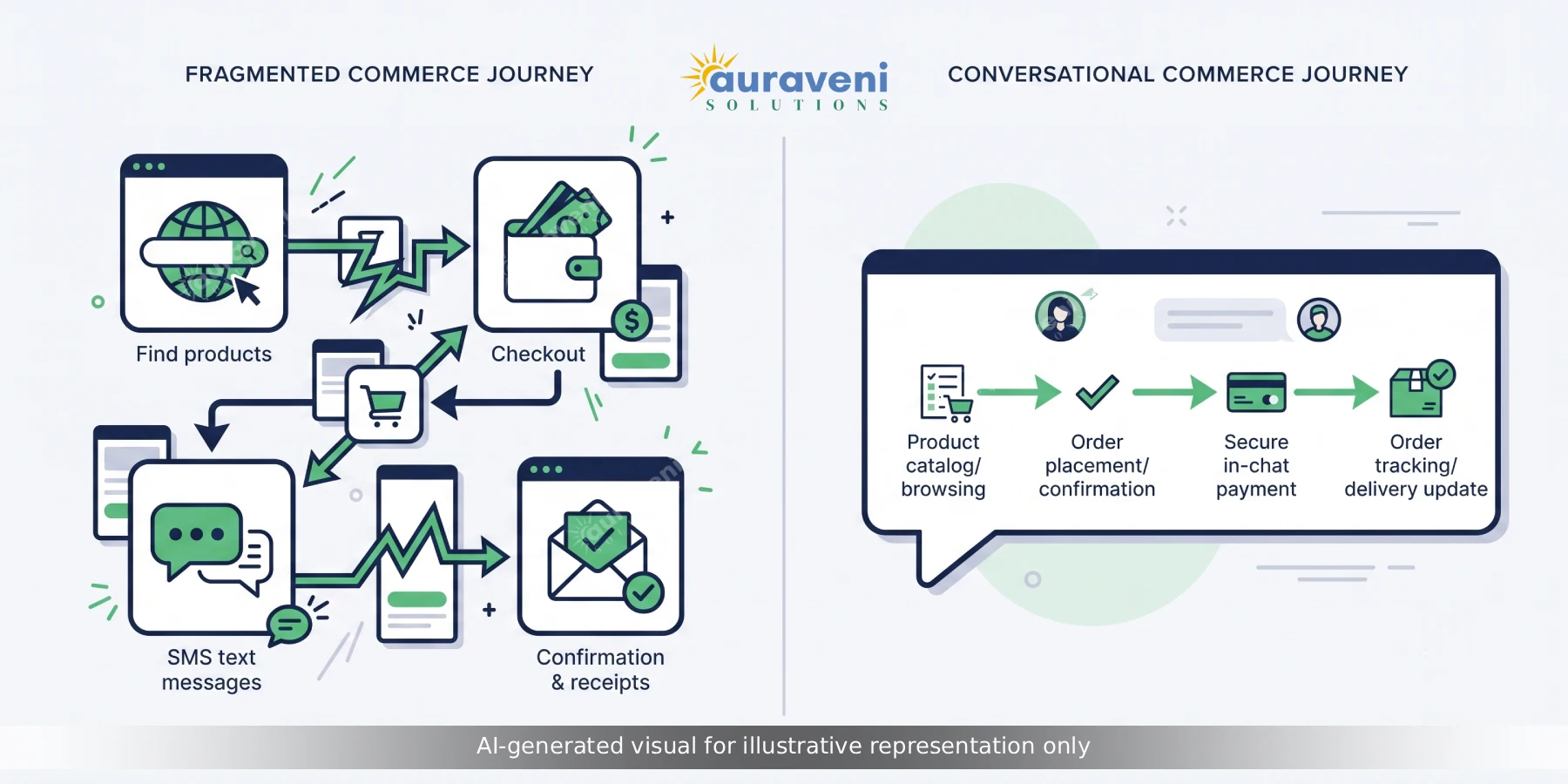
WhatsApp sidesteps all three problems at once: near-universal presence on the device already, delivery rates approaching 100% compared to SMS and email, and zero installation friction since the app is already open dozens of times a day. Metro consumers in India's Tier-1 cities now shop online six to eight times a month on average, and a growing share of that behaviour happens without ever opening a dedicated shopping app or website — the entire journey, from discovery to payment confirmation, increasingly happens inside a single chat thread.
The Adoption Gap: Business App vs Cloud API
This distinction is where a lot of businesses genuinely don't realise they're leaving value on the table. The free WhatsApp Business app is designed for a small team manually replying to messages — useful, but fundamentally limited to one device, minimal automation, and no meaningful integration with a CRM or order system.
The WhatsApp Cloud API is a different tier entirely: it enables automated flows, multi-agent routing, structured catalogue browsing inside the chat itself, webhook-based integration into a business's existing CRM or order management system, and template-based campaigns that can run at genuine scale. Cloud API adoption among Tier-1 India D2C, BFSI, and edtech businesses sits meaningfully higher, in the range of 38–52%, precisely because those sectors have the clearest, most immediate ROI case for automation. The much larger population of smaller Indian SMBs — the long tail under fifty employees — remains overwhelmingly on the free consumer app, largely because moving to the Cloud API requires proper technical integration work that most small teams don't have in-house capacity for.
What WhatsApp Flows Actually Enable
WhatsApp Flows are the feature most responsible for form, a product browser, a booking calendar — rather than a wall of text messages the customer has to read and respond to manually.
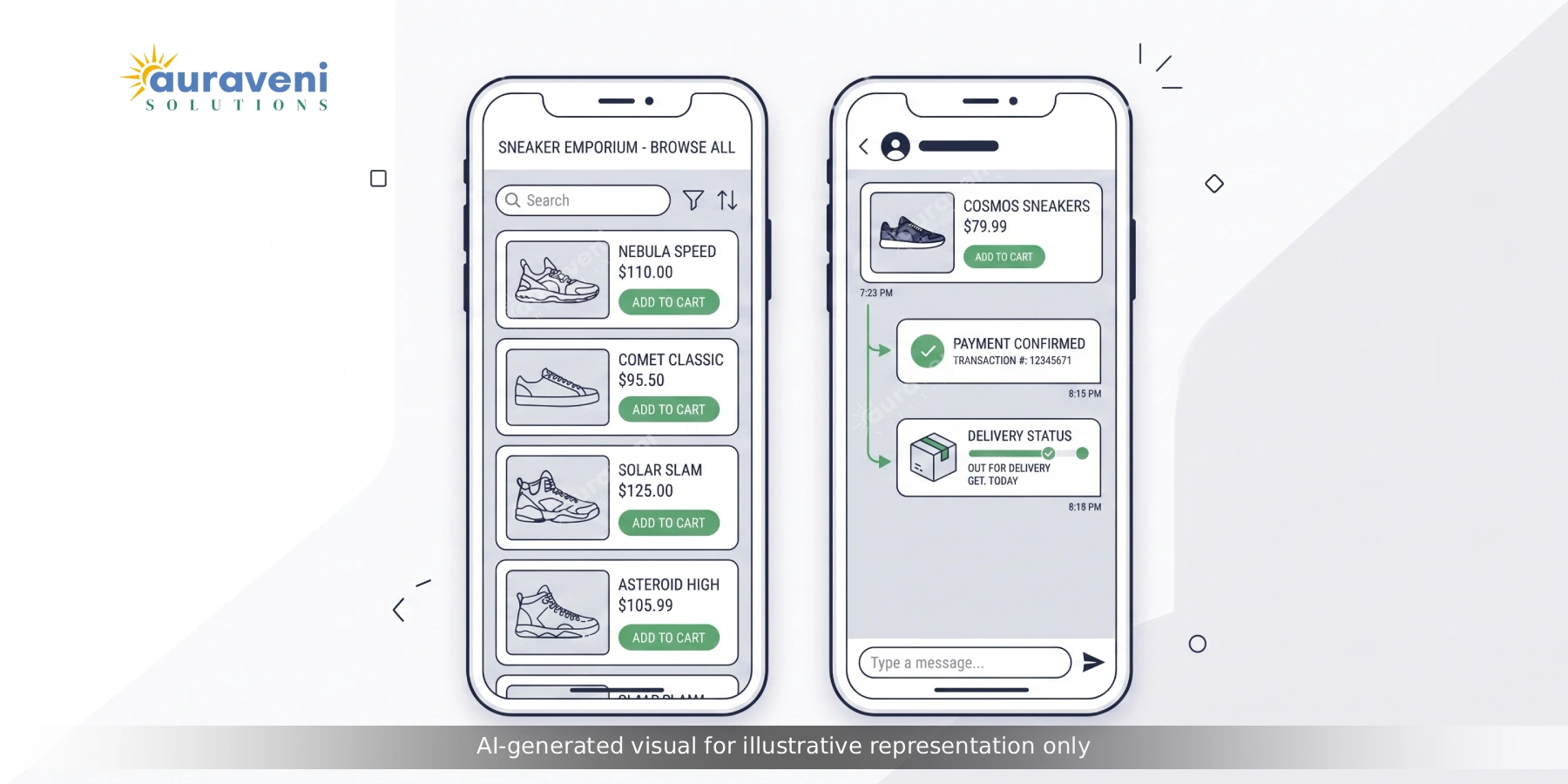
In practice, this means a customer can enter through an ad, browse a product catalogue with images and pricing, select variants, confirm a delivery address, and complete a purchase, all without the conversation ever leaving WhatsApp or forcing a jump to an external website. For businesses already running an eCommerce platform, this isn't a replacement for the website — it's a parallel, lower-friction entry point that converts a specific kind of high-intent, mobile-first customer who would otherwise abandon a multi-step website checkout.
Click-to-WhatsApp Ads and the New Attribution Problem
Click-to-WhatsApp (CTWA) ads — Meta ads that open directly into a WhatsApp conversation instead of a landing page — have become one of the highest-performing ad formats in the Indian market specifically, with some analyses showing conversion lifts approaching 94% and meaningfully lower cost-per-lead compared to standard landing-page ad flows.
The attribution challenge this used to create — a customer clicks an ad, has a conversation, and a sale happens with no clean way to trace it back to that specific ad — has largely been solved by Flows integrating natively with Meta's Conversions API. A structured Flow creates a genuine event trail: form completions, abandoned steps, and confirmed purchases can now be measured with roughly the same precision marketers expect from website conversion tracking, which matters enormously for Indian Tier-1 brands that have historically struggled to prove WhatsApp's actual revenue contribution to a finance team used to clean website analytics.
Where Conversational Commerce Delivers Measurable ROI
A few specific use cases consistently show the clearest, most defensible returns:
- Abandoned cart recovery. WhatsApp-based cart recovery messages are consistently outperforming email recovery by a wide margin — recovery rates in the range of 15–30% via WhatsApp compared to a typical 2–5% via email, largely because the message actually gets seen and read rather than sitting unopened in an inbox.
- Order updates and delivery tracking. Replacing SMS-based order updates with WhatsApp notifications reduces support ticket volume noticeably, since customers can ask a follow-up question directly in the same thread rather than calling a support line.
- Post-purchase engagement and repeat orders. Businesses running structured WhatsApp re-engagement flows report meaningfully higher repeat purchase rates than businesses relying solely on email for retention, largely because the message format matches how the customer already communicates day to day.
- First-response automation with clean handoff. AI-assisted first responses that handle common questions immediately, then hand off cleanly to a human for anything more complex, consistently outperform either a fully manual team (too slow to match WhatsApp's tighter response-time expectations) or a fully automated bot with no escape hatch (which frustrates customers with a genuinely complex issue).
What Changed in 2026: Pricing, Compliance, and the End of On-Premise
A few structural changes are worth knowing if you're evaluating this now rather than a year ago. Meta retired the self-hosted, on-premise version of the WhatsApp Business API, meaning every business now runs on Meta's Cloud API infrastructure directly or through an authorised business solution provider — simplifying the technical landscape but also meaning any legacy on-premise integration needs migrating.
Effective January 2026, India-specific pricing was restructured with native Rupee billing now available for Indian businesses, though existing dollar-billed accounts can't be converted retroactively, which is worth checking before assuming a straightforward switch. And as WhatsApp commerce scales, compliance scrutiny is tightening in parallel, particularly for regulated sectors like BFSI and healthcare, where template governance and data handling need to be treated as seriously as any other customer data channel — not as an informal messaging extension exempt from the same standards.
Choosing Between a Business Solution Provider and Direct Integration
One practical decision every business faces when moving to the Cloud API: integrate directly with Meta's infrastructure, or go through an authorised Business Solution Provider (BSP) that sits between the business and Meta, handling the underlying infrastructure and often bundling additional tooling like campaign dashboards and CRM connectors.
Direct integration gives a business full control over the technical implementation and typically the lowest per-message cost, but it also means the business's own team is responsible for the entire integration, monitoring, and compliance surface — a genuine undertaking for a team without prior messaging-API experience. Going through a BSP trades some of that cost and control for faster setup, built-in dashboards, and vendor support when something breaks, which is often the more sensible starting point for a business without in-house technical capacity to maintain the integration long-term.
Neither path is universally correct. A business with a capable in-house or partner development team building deep, custom-integrated commerce flows is often better served by direct integration, since it avoids paying a BSP margin on infrastructure the business's own team is fully capable of managing well long-term. A business that wants to move fast without taking on ongoing infrastructure ownership is usually better served starting with a reputable BSP and reassessing as volume and complexity grow over time.
Building It Properly: What a Real Implementation Involves
A genuinely well-built WhatsApp commerce integration involves more than connecting an API key. It needs a properly structured product catalogue synced with actual inventory (not a stale, manually updated list), Flow design that's genuinely tested for how real customers browse and drop off rather than assumed to work from a demo, webhook integration into the business's actual CRM or order system so a WhatsApp-originated sale shows up in the same reporting as every other channel, and clear automation boundaries with a fast, reliable handoff to a human — because a bot stuck in an unhelpful loop on a channel with WhatsApp's response-time expectations damages trust faster than almost any other channel failure.
How Auraveni Approaches WhatsApp Commerce Integration
We treat WhatsApp Cloud API integration the same way we treat any other API integration — with proper webhook handling, signature verification, and a reconciliation process rather than a fragile connection nobody's stress-tested, a discipline we cover in more depth in our guide to API integration strategy for growing businesses. For eCommerce clients specifically, we design WhatsApp as a genuine parallel commerce channel synced with the same inventory and order system powering the main storefront, an approach we also cover from the marketplace angle in our guide to multi-vendor marketplace development.
Conclusion
WhatsApp has quietly become commerce infrastructure in India, not just a support channel — and the gap between businesses using the free consumer app reactively and businesses running a properly integrated Cloud API commerce flow is now wide enough to show up directly in conversion, cart recovery, and repeat purchase numbers. With the vast majority of Indian SMBs still on the free tier, the businesses that move to a properly built Cloud API integration now are working with meaningfully less competition on the channel their customers already prefer.
If you're still running WhatsApp as a manual support line and want to understand what a properly integrated commerce flow would actually look like for your business, we're glad to walk through it.
