
























Building a Multi-Vendor eCommerce Marketplace in 2026: A Founder's Guide to Architecture, Vendor Payouts, and Launch
Introduction
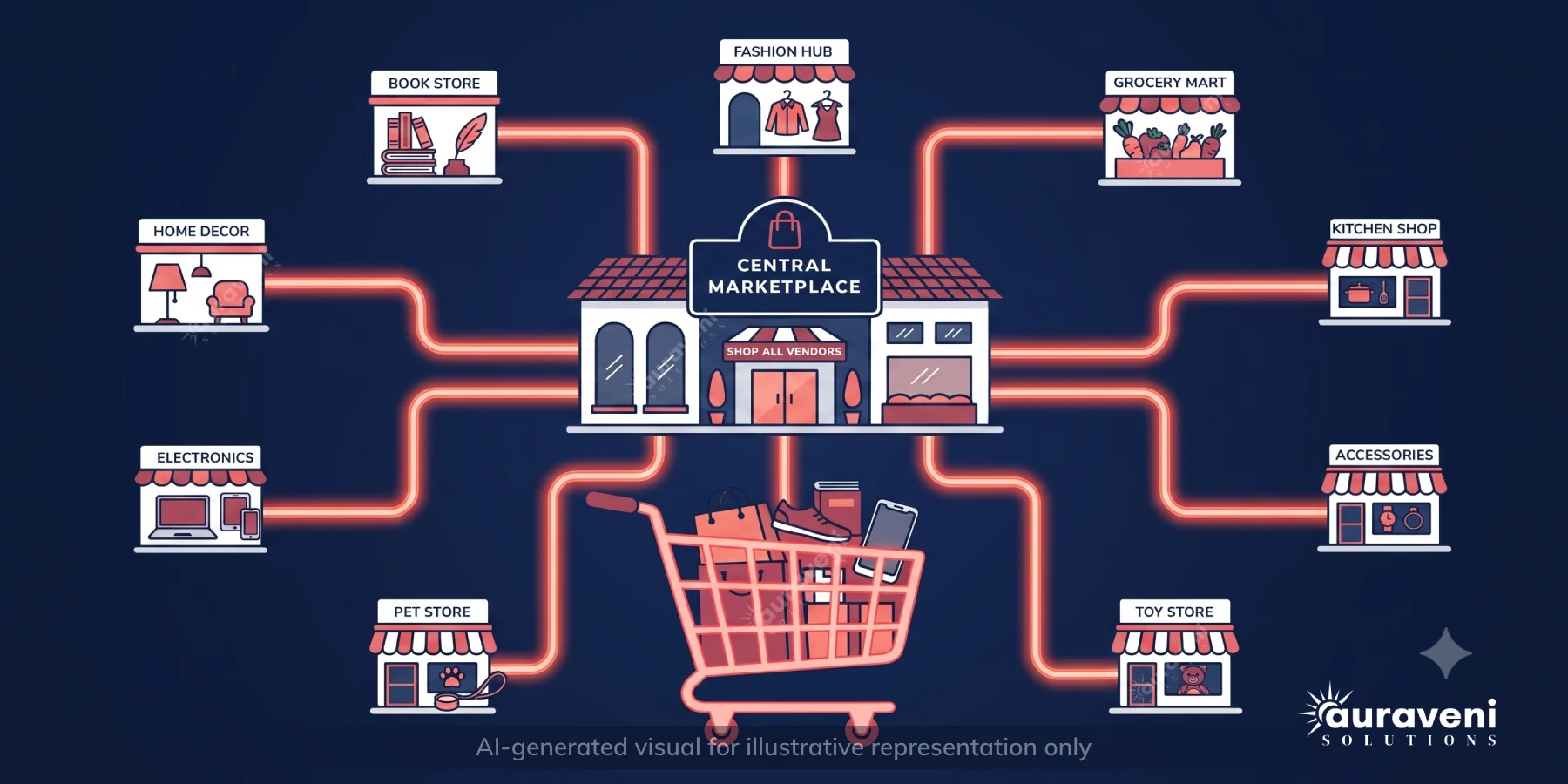
Every founder who comes to us wanting a "marketplace like Amazon" has roughly the same mental model: a website where multiple sellers list products, and the platform takes a cut. That part is correct. What's usually missing is everything underneath it, the layer that decides whether the business survives its first eighteen months.
We've now scoped, designed, or built marketplace platforms across cafes, B2B pharma distribution, agritech, and luxury retail (our own in-house brand among them), and the pattern repeats. The founders who treat a marketplace as "an eCommerce site with extra logins" run into walls around month four, usually right when their first real payout dispute lands in their inbox. The founders who plan for vendor accounting, split payments, and onboarding friction from day one are the ones still standing at month eighteen.
This guide is written from that second seat. We're not going to repeat the generic "what is a marketplace" definition you've already read on five other blogs. We're going to walk through the decisions that actually determine whether your platform scales or stalls.
What Actually Makes a Marketplace Different From a Webstore
A regular eCommerce store has one seller, one inventory system, and one bank account on the receiving end of every transaction. A marketplace breaks every one of those assumptions at once.
The moment a single cart can contain products from three different vendors, you've taken on problems that don't exist in single-vendor commerce:
- Order splitting One checkout, three (or more) separate fulfilment threads, each with its own shipping timeline and tracking number.
- Split payments The buyer pays once; the money has to be divided correctly between the platform's commission and each vendor's share, automatically, every single time.
- Independent inventory ownership Vendor A's stock count has nothing to do with Vendor B's, and your platform needs to know the difference without you manually checking.
- Distributed accountability When something goes wrong with an order, "who is responsible" is suddenly a real question with legal and reputational weight.
None of this is exotic engineering. It's well-understood territory. But it has to be designed in from the start, because retrofitting split-payment logic onto a single-vendor cart system later is genuinely one of the more painful migrations in eCommerce development. We've inherited a few of these rebuilds, and they always cost more than building it correctly the first time would have.
The Five Architectural Decisions You Cannot Defer
If you take nothing else from this article, take this section. These are the five decisions that are cheap to make correctly on day one and expensive to unwind later.
- Who owns the customer relationship, you or the vendor?
In a true marketplace model (the Amazon/Flipkart pattern), the platform owns the customer relationship end-to-end: checkout, support, returns, even communication tone. Vendors are, from the buyer's point of view, almost invisible. In a federated model (closer to Etsy), individual vendor branding stays visible throughout the journey, and buyers form a relationship with the seller, not just the platform.
This single decision changes your database schema, your checkout UI, your support ticketing workflow, and your branding guidelines. Decide it before a single wireframe gets drawn.
- How granular does vendor-level inventory control need to be?
A handmade jewellery marketplace with 200 SKUs per vendor has very different inventory needs from a grocery marketplace with real-time stock fluctuation across dozens of dark stores. Get the data model right here and stock-sync headaches mostly disappear. Get it wrong and you'll be firefighting overselling issues during your first big sale event.
This single decision changes your database schema, your checkout UI, your support ticketing workflow, and your branding guidelines. Decide it before a single wireframe gets drawn.
- What happens when an order spans multiple vendors and one vendor cancels?
This sounds like an edge case until you've run a marketplace for six weeks. Partial cancellations, partial refunds, and partial shipping delays are not edge cases, they're Tuesday. Your platform needs explicit, tested logic for partial-order states, not a workaround bolted on after a support ticket escalates.
- Will vendors need their own sub-storefronts, or just product listings inside your storefront?
Sub-storefronts (each vendor gets a branded mini-site within your domain) increase vendor satisfaction and retention significantly, because vendors feel like partners rather than line items. They also add real frontend and CDN complexity. Decide based on whether vendor loyalty or build speed matters more in your first six months.
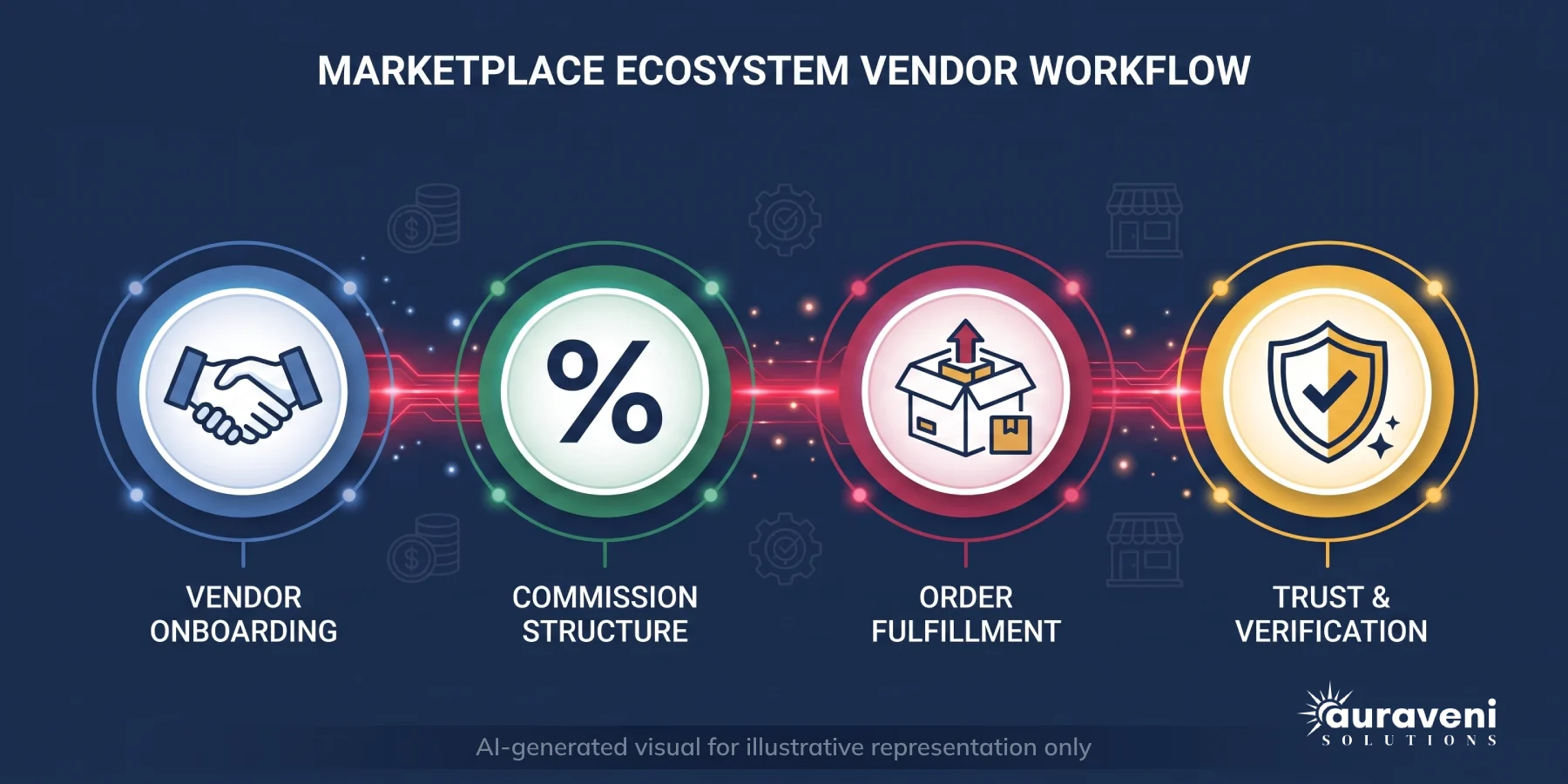
- How will you verify vendors before they go live?
KYC and catalogue-quality checks feel like friction you can "add later." In practice, the marketplaces that skip this end up with a credibility problem that's much harder to fix after launch than before it. Even a lightweight manual verification step at launch (document upload, sample product review, a short call) saves you from your first fraud incident or counterfeit-goods complaint.
Choosing a Commission and Payout Model That Vendors Won't Resent
Roughly four monetisation patterns dominate functioning marketplaces today: a percentage commission per sale, a flat subscription fee, a per-listing fee, or a hybrid of commission plus premium placement fees. Commission-based models remain the most common because they scale naturally with vendor success, you earn more when your vendors earn more, which keeps incentives aligned on both sides.
Commission rates vary enormously by category and geography. Fashion and lifestyle marketplaces commonly sit in the 15–20% range, electronics and high-ticket items often run lower at 5–8% because margins are thinner, and service-based marketplaces can justify commissions up to 25–30% since there's no physical inventory cost to the vendor. There's no universal "correct" number, the right commission is whatever keeps your unit economics healthy while still being low enough that a vendor's margin survives after your cut, payment processing fees, and their own cost of goods.
A pattern worth borrowing from more mature marketplace strategy: graduated commission onboarding. Many growing marketplaces offer reduced or zero commission for a vendor's first 30 days, then step the rate up gradually over the following months. This lowers the activation barrier for your first cohort of vendors, the ones whose early reviews and catalogue depth will determine whether your cold-start problem resolves or compounds, without permanently sacrificing your margin.
On the technical side, the payout layer is where most underbuilt marketplaces show their seams. At minimum, your system needs to:
- Calculate commission automatically at the point of sale, not in a batch job run manually at month-end
- Hold funds in an "unclear balance" state until the return window closes, then move them to a "clear balance" vendors can actually withdraw
- Support partial refunds without breaking the commission math
- Generate vendor-facing statements that are legible to someone who isn't an accountant
- Handle TDS/TCS withholding correctly if you're operating in India (more on this below)
This is the exact ledger architecture, unclear balance, clear balance, rolling withdrawal logic, that we've built for our own in-house marketplace project, and it's the layer that separates marketplaces vendors trust from ones they quietly abandon after their first confusing payout.
The Tech Stack We'd Actually Recommend in 2026
Stack choice depends on your scale ambitions, but here's what we're actually specifying for marketplace builds right now:
Frontend: React or Next.js for the buyer-facing storefront (Next.js specifically when SEO and fast initial page loads matter, which for a marketplace, they always do). Vue is a reasonable alternative if your team already has Vue depth, the framework war here matters less than consistent component architecture.
Vendor dashboard: A separate application, not a bolted-on view inside the main storefront codebase. Vendors need their own login, their own permission boundaries, and a UI built for operational tasks (bulk uploads, order management, payout history) rather than browsing. Treating it as a separate product from day one keeps both experiences cleaner.
Backend: Node.js with Express, or PHP Laravel, depending on team familiarity and the complexity of your business logic. Laravel's built-in queueing and scheduled job tooling is genuinely well-suited to marketplace operations, commission calculations, payout batching, and inventory sync jobs all benefit from a mature job-queue system rather than synchronous processing.
Database: PostgreSQL or MySQL for transactional data (orders, vendors, payments), relational integrity matters enormously here because money is involved. MongoDB can sit alongside it for catalogue data and product attributes that vary wildly between categories and don't fit a rigid schema well.
Payments: Razorpay Route or Cashfree for split payments if you're India-focused; Stripe Connect if you're serving international vendors. Whichever you choose, build your order record before calling the payment gateway, not after. If the gateway call fails after your record exists, you have a recoverable state. If it's the other way around, you have an orphaned transaction and a support ticket.
Cloud infrastructure: AWS remains our default recommendation for marketplace workloads specifically because of how well S3, RDS, and Lambda combine for the kind of bursty, image-heavy, transaction-sensitive traffic marketplaces generate. We cover this in more depth in our AWS cloud architecture guide for startups.
The Cold-Start Problem Nobody Mentions in the Pitch Deck
Every marketplace faces the same chicken-and-egg problem: buyers won't come without vendors, and vendors won't join without buyers. This isn't a technology problem, and no amount of clever engineering solves it directly, but your platform's design can make the cold start meaningfully easier or meaningfully harder.
A few practical levers that work: launch with a narrow, well-curated category rather than trying to be "everything" on day one. Recruit your first ten to twenty vendors personally rather than through a generic sign-up form, quality and responsiveness matter more in the first cohort than volume. And build your vendor onboarding flow to be fast enough that a motivated seller can go from sign-up to a live, approved listing in under a day, because every extra hour of friction in onboarding is an hour where that vendor reconsiders.
Compliance: GST, TCS/TDS, and Vendor KYC for Indian Marketplaces
If your marketplace operates in India, there are a few compliance realities your platform's accounting layer needs to handle correctly from the first transaction, not retrofitted after a tax notice arrives:
- TCS under GST Section 52 applies to eCommerce operators facilitating supply through their platform. You're generally required to collect tax at source on the net value of taxable supplies made through your marketplace.
- TDS obligations can apply depending on vendor payout structure and thresholds, and this interacts with your payout ledger directly. It needs to be calculated at the point of payout generation, not reconciled manually afterward.
- Vendor GST registration verification should be part of your onboarding KYC, not a separate manual process someone remembers to do later.
This is the exact ledger architecture, unclear balance, clear balance, rolling withdrawal logic, that we've built for our own in-house marketplace project, and it's the layer that separates marketplaces vendors trust from ones they quietly abandon after their first confusing payout.
What Auraveni Builds Differently
We're not a marketplace template shop. Every multi-vendor platform we've scoped, across hospitality, agritech, B2B distribution, and our own luxury retail venture, has needed a genuinely different commission structure, a different vendor verification depth, and a different inventory model. We design the vendor financial layer (unclear/clear balance logic, rolling withdrawal ledgers, TDS/TCS-aware payout generation) as a first-class part of the architecture, not an afterthought bolted onto a generic eCommerce theme.
If you're earlier in the process and still validating whether you need a marketplace at all versus a simpler eCommerce storefront, our guide on what to look for in a software development partner is a useful gut-check before you commit to either path.
Conclusion
A multi-vendor marketplace is not a bigger eCommerce store, it's a different business with a different operational core. The platforms that succeed are the ones where vendor trust, payout transparency, and order-splitting logic were treated as architecture decisions from day one, not features added after the first vendor complaint. If you're building one in 2026, get the commission model, the payout ledger, and the vendor onboarding flow right before you worry about which framework renders your homepage faster.
Talk to us before you scope your build, it's a conversation that costs nothing and tends to save founders months of expensive rework later.
FAQ
A regular eCommerce website has one seller and one inventory system behind every transaction. A multi-vendor marketplace allows multiple independent sellers to list and sell their own products through a shared storefront, which requires order splitting, per-vendor inventory, and automated commission-based payouts that a single-vendor store never needs to handle.
