
























System Architecture Design: Avoiding Technical Debt
Introduction
In 2018, Japan's Ministry of Economy, Trade and Industry published a warning that became famous enough in Japanese business circles to earn its own nickname: the "2025 Digital Cliff." The government's own analysis projected that if Japanese enterprises didn't modernise their aging, poorly documented IT systems, the accumulated cost of maintaining that legacy technology — rather than building on top of something sound — could reach roughly 12 trillion yen, or about $80 billion, every single year.
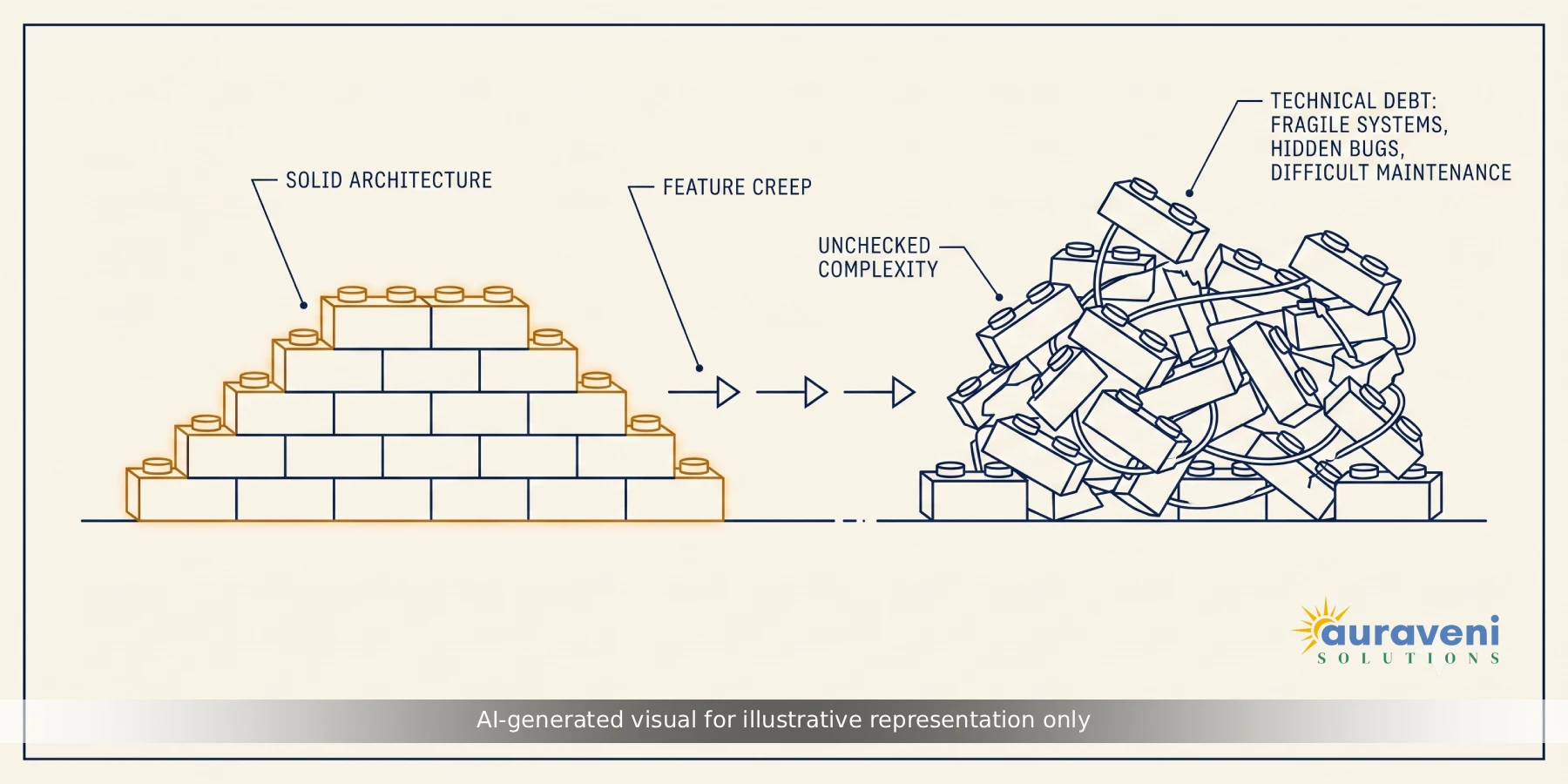
That number is Japan-specific, but the underlying mechanism isn't a Japan-specific problem at all. It's what happens to any system, in any country, built without a deliberate architecture behind it: workable at first, then slower to change, then actively resistant to change, then finally so brittle that every new feature costs more than the last one did. System architecture design is the discipline that exists specifically to prevent that trajectory — and it's one of the most consequential, least glamorous decisions a growing business makes.
What System Architecture Design Actually Covers
System architecture is the set of foundational decisions about how a software system is structured before the first line of application code gets written: how components communicate with each other, how data flows and where it's stored, how the system scales under load, how failures are contained rather than cascading, and how new features get added without requiring a rewrite of everything around them.
Get this right, and a system can grow for years without a painful rebuild. Get it wrong, and even small feature requests start requiring disproportionate effort, because every change has to work around structural decisions that were never designed to support what the business became. The frustrating part is that bad architecture rarely looks bad on day one. It looks perfectly fine — right up until the system needs to do something it wasn't built for.
Japan's "2025 Digital Cliff" and Why It's a Warning for Everyone, Not Just Japan
The Japanese government's own research found that roughly 80% of enterprise IT systems in the country had become what analysts call "black box" legacy — undocumented, built on outdated technology stacks, maintained by an aging pool of engineers who understood the original design, and so deeply embedded in daily operations that replacing them felt nearly impossible. A parallel study found that while roughly 80% of businesses in the US and Germany felt their digital transformation efforts had succeeded, only about 30% of Japanese companies said the same, with nearly a third reporting no meaningful results at all.
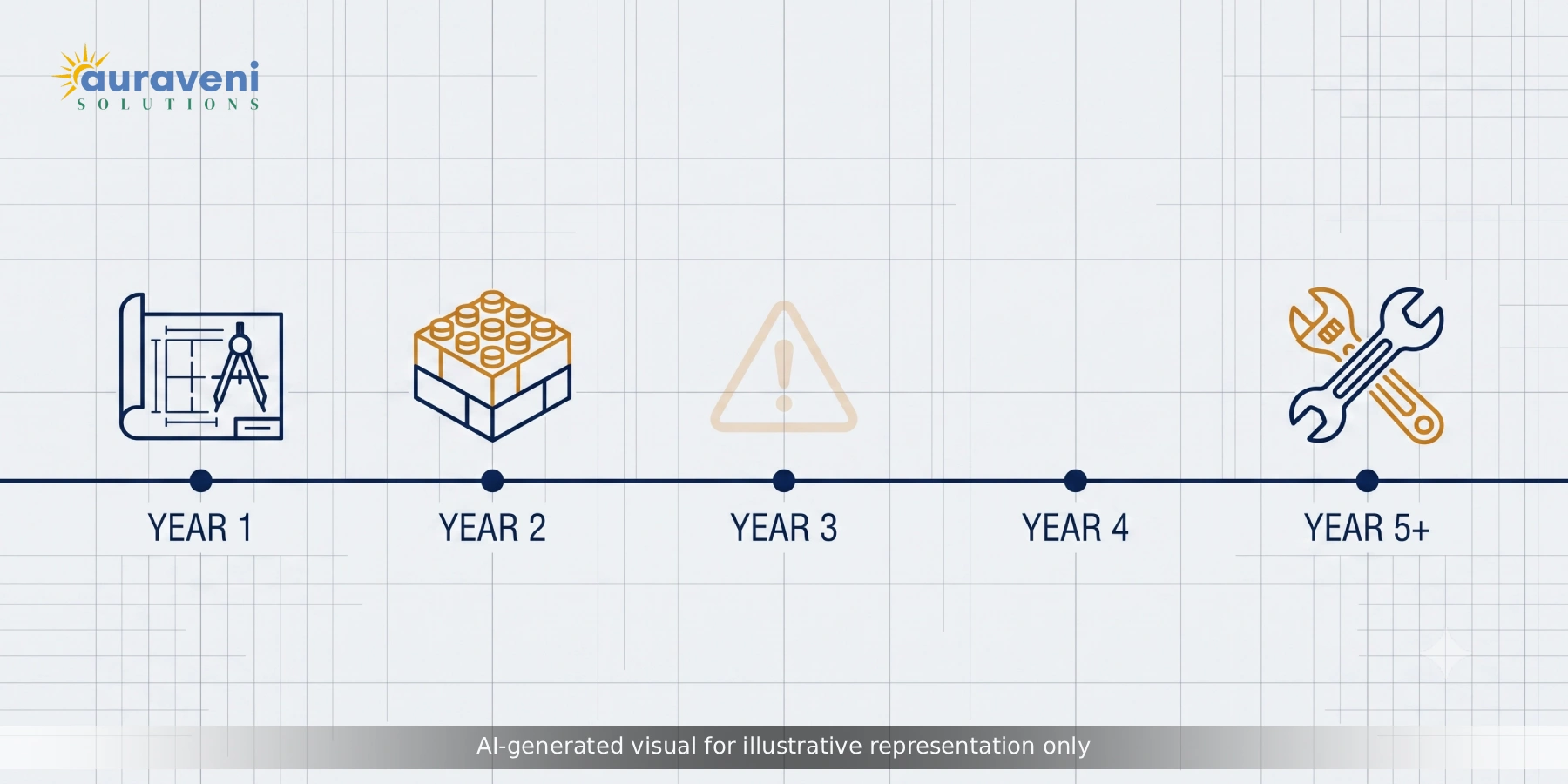
The lesson generalises well beyond Japan. A recent enterprise technology survey across Indian organisations found the exact same underlying risk being named by analysts in a very different market: businesses that saw a spending surge — whether during the early-2000s shift to service-oriented architecture or the AI-driven surge happening right now — often end up creating "the legacy tech of tomorrow," technology platforms that look modern on delivery but calcify into the next generation's technical debt within three to five years, because the architecture underneath was never given the same attention as the feature list on top of it.
The pattern is universal: systems built under time pressure, without deliberate architecture decisions, tend to work fine for the first year or two and then become progressively more expensive to change — right around the time a growing business most needs to move fast.
The Architecture Decisions That Are Cheap Now and Expensive Later
A handful of decisions are disproportionately expensive to reverse once a system is live, which is exactly why they deserve real time before development starts rather than being decided implicitly by whatever the first developer happened to be comfortable with.
- How components communicate with each other. Tightly coupled systems, where every part directly depends on the internal details of every other part, are fast to build initially and brutal to change later, because a single update can have unpredictable ripple effects across the entire system. Designing clear interfaces between components — even within what's technically still a single application — pays for itself the first time a business needs to swap out or scale one piece independently.
- Where and how data lives. A data model designed around today's immediate feature list, without room for how the business will actually use that data in eighteen months, is one of the most common sources of expensive rework we see. Data architecture decisions are disproportionately hard to change after a system has real production data in it, which makes them worth genuinely deliberate upfront design rather than "we'll fix it later."
- How the system handles failure. Systems designed only for the happy path — assuming every dependency, every network call, every third-party service will always work — fail catastrophically the first time something upstream doesn't. Designing for graceful degradation and failure containment from the start is far cheaper than retrofitting resilience onto a system that's already live and already depended upon.
- How authentication and access control are structured. Bolting proper role-based access control onto a system after launch is one of the more painful retrofits in software development, because access rules end up threaded through code that was never designed to check them consistently.
Monolith, Microservices, or Something in Between
This is the architecture debate that gets the most attention, and it's also one where the "correct" answer depends entirely on scale and team structure, not on which pattern is more fashionable.
A well-structured monolith — a single, unified application — is often the right starting point for a new product. It's faster to build, easier for a small team to reason about, and avoids the very real operational overhead that comes with running and coordinating multiple independent services. The mistake isn't choosing a monolith; it's building an undisciplined one, where internal boundaries between features are never respected and everything becomes tangled together regardless of the deployment model.
Microservices — breaking a system into independently deployable services — earn their complexity when a system has grown large enough that different parts genuinely need to scale independently, when multiple teams need to work and deploy without blocking each other, or when different components have meaningfully different technical requirements. They are not a starting point for most new products; they're a evolution that a system grows into once a monolith's limitations become a genuine, specific operational problem.
The middle ground — a modular monolith, with clean internal boundaries between features that could later be extracted into services if needed — is, for most growing businesses, the pragmatic answer that avoids both premature complexity and the tangled-mess failure mode of an undisciplined monolith.
Cloud-Native Architecture: What It Actually Means Beyond the Buzzword
"Cloud-native" gets used loosely enough that it's worth defining precisely: it means a system is designed from the start to take advantage of what cloud infrastructure actually offers — automatic scaling, managed databases, distributed resilience — rather than simply having an existing application moved onto cloud servers and called cloud-native by association.
A genuinely cloud-native architecture treats infrastructure as something the application can request and release dynamically rather than something fixed and manually provisioned. It's designed to survive individual component failures without the whole system going down. And it separates configuration from code so the same application can run across development, staging, and production environments without manual reconfiguration at each step. We go into the specific service-level decisions — compute choices, database selection, cost optimisation — in more depth in our companion piece on AWS cloud architecture for startups.
Signs Your Current Architecture Is Already Costing You
A few patterns tend to show up well before a system reaches a genuine crisis point, and they're worth taking seriously as early warnings rather than waiting for a full outage to force the conversation: feature requests that used to take days now consistently take weeks, with no corresponding increase in feature complexity to explain it. Bug fixes in one part of the system unpredictably break something unrelated. Onboarding a new developer takes months instead of weeks because no one can fully explain how the pieces fit together. And any change to the system requires "the one person who understands that part" to be personally involved, creating a single point of failure that has nothing to do with the technology and everything to do with how undocumented and tangled the architecture has become.
None of these individually means a system needs a full rebuild. Collectively, and especially if several are true at once, they're a strong signal that an architecture review — not necessarily a rewrite — is overdue.
What a Proper Architecture Review Actually Involves
A genuine architecture review isn't a checklist exercise. It typically starts with mapping how the system actually behaves in production today — not how the original documentation says it should behave, since those two things drift apart faster than most teams expect. From there, it identifies which parts of the system are genuinely load-bearing and fragile versus which parts are simply unfamiliar, prioritises the handful of changes that would meaningfully reduce risk or unlock the business's near-term roadmap, and — critically — produces a realistic, incremental plan rather than a recommendation to rebuild everything at once, which is rarely necessary and almost always more disruptive than the problem it's meant to solve.
How Auraveni Approaches System Architecture Design
We treat architecture as a business conversation before it's a technical one: what does this system need to support in eighteen months, not just at launch, and where is the business most likely to need to move fast later. That framing shapes decisions about data modelling, service boundaries, and cloud infrastructure from the very first design session, rather than architecture being retrofitted onto whatever got built fastest. For systems that already exist and are showing early strain, we run focused architecture reviews that prioritise the highest-risk, highest-leverage changes rather than recommending a wholesale rebuild.
If you're earlier in scoping a new system and haven't yet settled on a development partner, our guide on what to look for in a software development partner covers the broader evaluation questions worth asking alongside architecture specifically.
Conclusion
Japan's government put a number on what bad system architecture costs at national scale, but the mechanism behind that number plays out identically at the scale of a single growing business: systems built without deliberate architecture decisions work fine at first and become progressively, quietly more expensive with every year that passes, until a business finds itself unable to move as fast as it needs to. The fix isn't waiting for a crisis to force a full rebuild — it's treating architecture as a first-class decision from the start, and reviewing it honestly before the warning signs become a genuine constraint on growth.
If any of the warning signs in this article sound familiar, it's worth having that conversation before they compound any further.
FAQs
System architecture design is the set of foundational decisions made before development begins about how a software system is structured — how its components communicate, how data is stored and flows, how it scales, and how it handles failure. Good architecture allows a system to grow for years without requiring a painful rebuild.
